
You can’t teach an old dog new tricks. Or can you?
I’m about to find out with Rocky, my golden retriever. He’s a little over two years old—not “old” old, but old enough to have settled into a few habits that are getting him in trouble at the dog park.
I’ve started looking for trainers. The real test will not be whether he can learn a new behavior in the moment. It will be whether the new behavior is still there after the trainer leaves and the next dog shows up.
Workplaces have the same problem. The first time you clean something up, people can usually follow along. The harder part is whether the new pattern survives the next shift, the next quarter, or the next person who has been doing it the old way for years.
In the late 90s and early 00s I watched manufacturing move overseas while some of the people running the plants treated the change as temporary. Databases turned out to be easier to reason with than plant managers who had already decided the old way was good enough. The paycheck eventually made the case. The habit did not change until the cost of keeping the old habit became obvious.
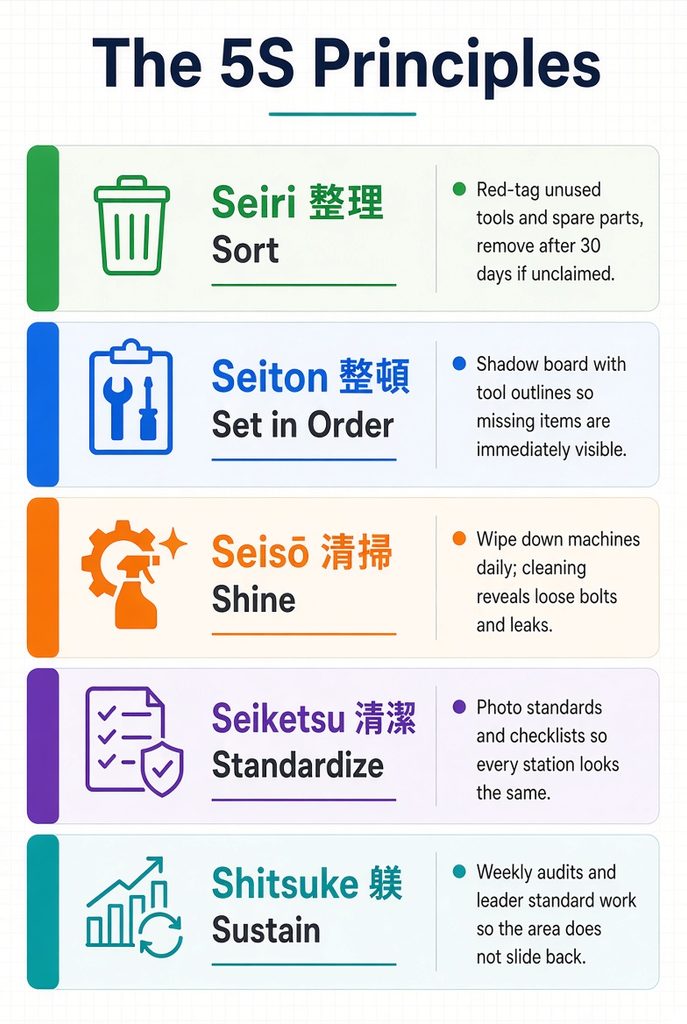
The last post covered the first three S’s of 5S. They change the floor. Sort, Set in Order, and Shine are the training session. Standardize and Sustain are what determine whether the new behavior is still there after the trainer leaves.
In the plant we learned that the hard part was not the initial cleanup. Anyone can red-tag spare parts and wipe down a machine once. The hard part was making sure the next shift did not put the tools back in the junk drawer and leave the oil stain for someone else. Standardize turned the cleanup into a repeatable pattern. Sustain turned the pattern into the way the area was run.
Standardize
Standardize is the photo on the wall. After Sort, Set in Order, and Shine, you take a picture of the station the way it is supposed to look and you post it. Anyone who walks up can compare the actual condition to the standard without asking.
In a data environment the equivalent is narrower and more useful than a style guide. It is the short list of rules that make the first three S’s visible in the catalog:
- Layer boundaries that are written down (bronze lands, silver conforms, gold is the version the business has agreed to use).
- Naming rules that already do the work of making unused objects obvious (singular tables, internal prefixes, verb-style procedures).
- A PendingRemoval or other quarantine schema with a published reclaim window and an automated drop job.
- One certified definition per critical entity, owned by a named person.
When those four things exist as written standards rather than tribal knowledge, a new engineer can open the catalog and know which table is the real member dimension and which one is still a landing zone. Most teams never write them down. They clean once, then spend the next year explaining why three tables still claim to be “the” customer.
Sustain
Sustain is the audit that doesn’t wait for an incident. On the floor it was the weekly walk with a checklist. Empty outlines on the shadow board, oil on the floor, red tags that had been ignored—all of it got noted and assigned before it became the next breakdown.
In data the same discipline looks like a short, recurring review of one subject area:
- Objects in PendingRemoval that no one reclaimed.
- Silver checks that have gone silent.
- New tables or columns that appeared without a grain statement or an owner.
- Dashboards whose usage has dropped to zero.
The review does not need a new platform. It needs the same person who already answers for the data—the owner—to look at the list and decide what stays, what moves, and what gets dropped. The technical steward implements the change. The owner answers for whether the standard still holds. Without that loop, the first three S’s are a project. With it, they are the way the area is kept.
Most data environments treat cleanup as a one-time event. The standards are never written, the audit never happens, and the inventory fills back up.
You can teach the old dog a new trick. Standardize and Sustain are how you find out whether the trick is still there after the trainer leaves. Write the four rules for one domain. Schedule the review. Name the person who answers for the list. The rest of the warehouse can wait until that corner stays clean without a special project.